Sign in to a platform
English EN

Your wishlist is empty
Your comparison list is empty
Your cart is empty
Wi-Fi antenna range
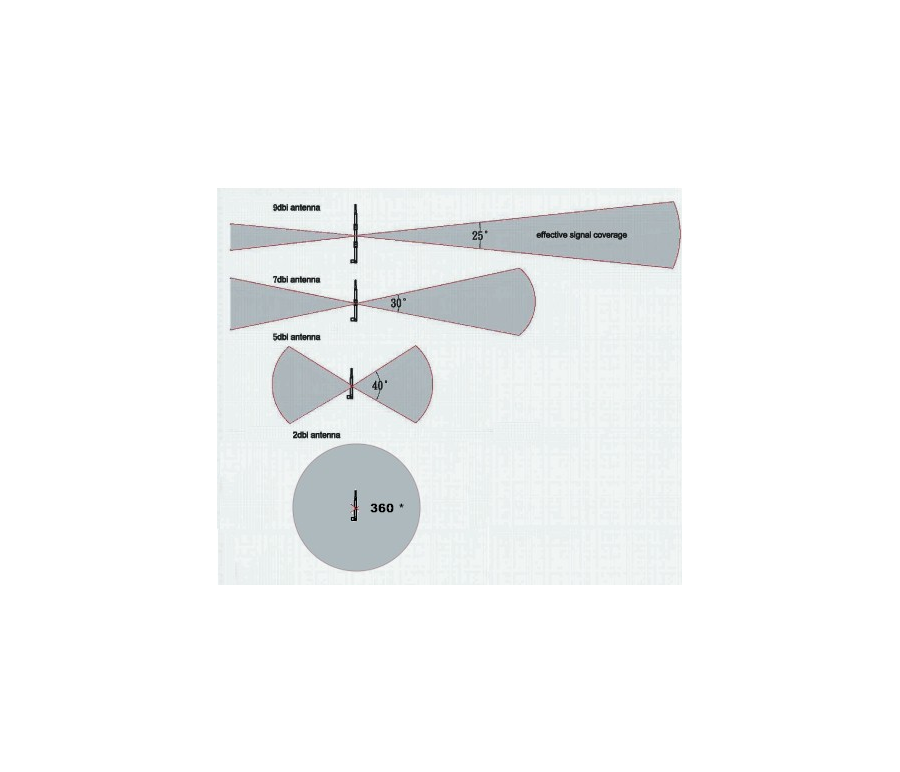
Radio waves travel in a straight line and do not pass through obstacles. Every material reflects them to some degree, and metal reflects them strongly. That is why, under the 802.11b/g protocols, Wi-Fi devices often fail to cover even a single house. It is also why an antenna sitting right against your computer's case loses a great deal of its range. Place wireless devices at about mid-height in the room they serve, and always away from walls.
Replacing the antenna on a wireless device with a higher-gain one raises both the transmitter's effective radiated power and the receiver's sensitivity. Your signal travels considerably further, and at the same time your receiver "hears" much weaker signals that it would have missed without the high-gain antenna. High gain is not always the answer to a coverage problem, though. The right antenna is the one that solves the particular problem in front of you.
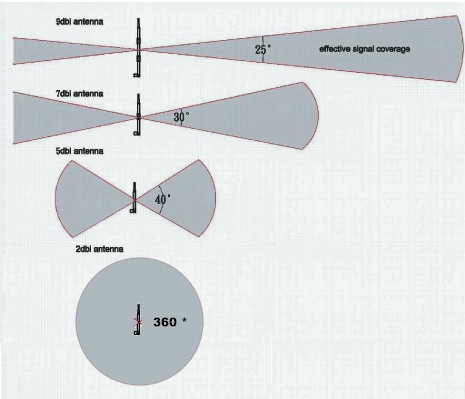
Low-gain antennas suit local mesh networks. High-gain antennas are for sending the signal a long way to one specific point — and from there you can distribute it again through wireless mesh nodes fitted with low-gain antennas.
The table below gives an approximate range for a 2.4GHz Wi-Fi device transmitting at 100 mW, according to the antenna used. These figures assume a clear line of sight throughout. Put buildings, trees or any other obstruction between the two points and the range drops sharply — in some cases to no more than 10 metres.
| Antenna Gain | Wireless Range |
| 0dB | 200m |
| 4dB | 440m |
| 7dB | 620m |
| 10dB | 1.2km |
| 13dB | 2.8km |
| 16dB | 5.0km |
| 20dB | 12.5km |
| 24dB | 31km |
Comments
No posts found
GPS Tracking Solutions
- All GPS Tracking Solutions
- GPS Tracking for Boats & Jet Ski
- GPS Tracking for Construction Machinery
- GPS Tracking for Corporate Fleets
- GPS Tracking for Agricultural Machinery
- GPS Tracking for Rental Vehicles
- GPS Tracking for Transport & Logistics
- GPS Tracking for Refrigerated Trucks & Cold Chain
- GPS Tracking for Commercial Vans & Deliveries
Information
- Authorised Dealer of TELTONIKA Telematics
- Authorised Dealer of MOTOROLA Solutions
- Authorised Dealer of STELLADORADUS
- Authorised Dealer of KIRISUN
- Store address
- Manufacturers
- Contact us
- About the company
- Blog

Useful
© 2001-2026 GPScom Technologies · Commercial Reg. (GEMI) No. 180170606000