
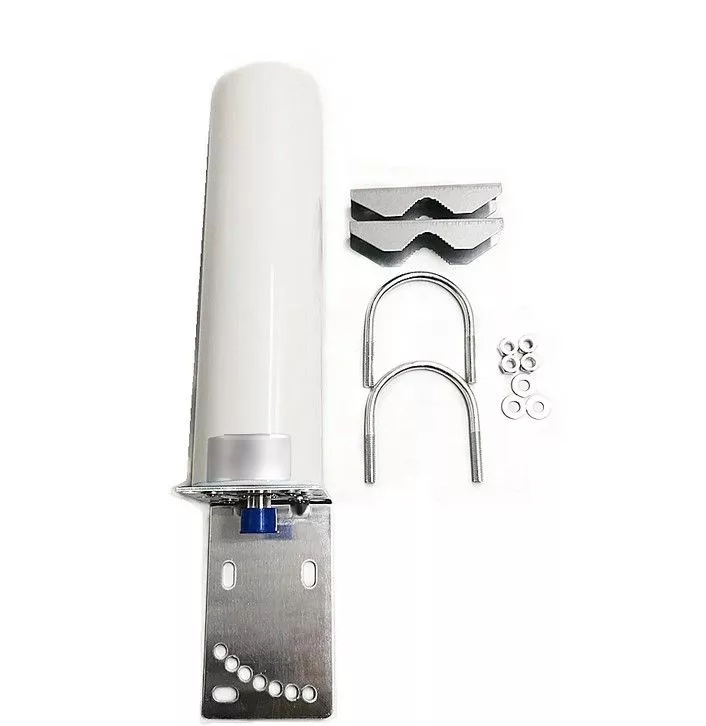
 The Arrow SC-558 is a compact multi-band omnidirectional (Omni) 4G/5G antenna, with a rugged housing resistant to vibration and harsh weather conditions.
It covers the frequency range 600–6000 MHz and is fully compatible with the standard 4G LTE & 5Gbands. It can be used on GSM / LTE / 5G / WiFi networks, reliably increasing range, the signal strength and the data rate with a gain of up to 14 dBi.
Thanks to the omnidirectional nature (Omni) , the antenna does not need special alignment toward the mobile carrier's base station; it can be installed easily and “see” signal in a full 360° circle around it.
In addition, thanks to the high-quality materials used (ABS radome, stainless steel) and the IP66 rating, the Arrow SC-558 is suitable both for marine use (marine grade) and for installation in demanding outdoor environments (rain, sun, salt, an aggressive marine environment).
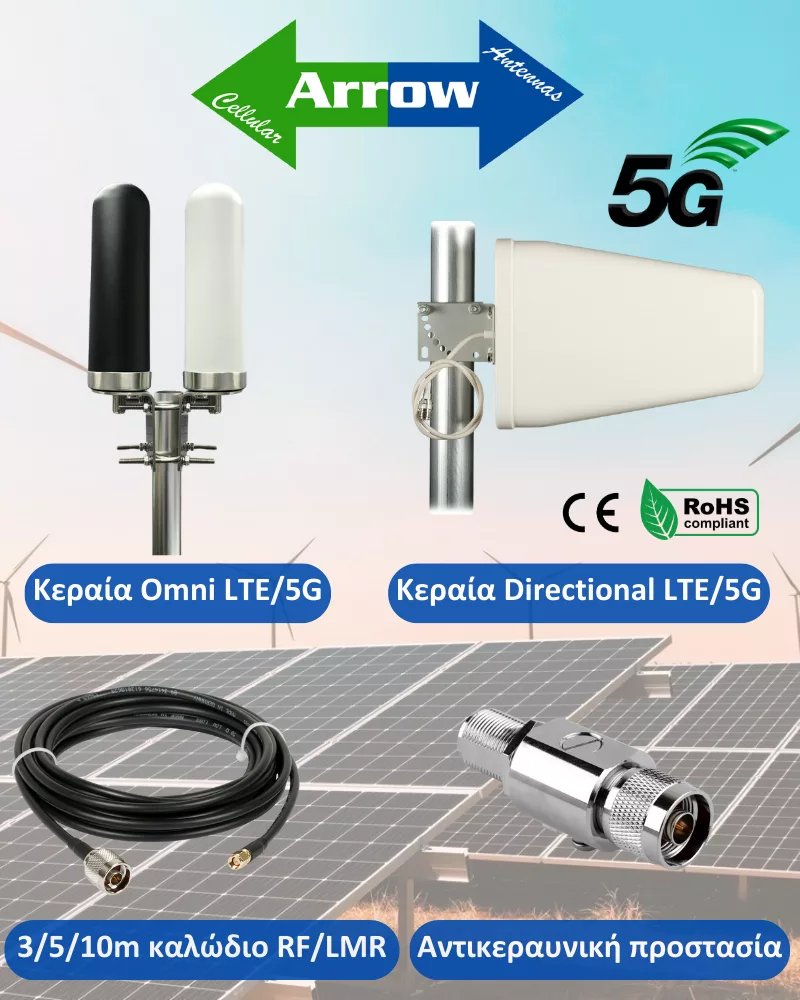
It is an ideal Omni 4G/5G antenna solution for installations such as:
- Systems for HEDNO Power Plant Controllers (PPC) at electricity generation stations
- Installations at solar parks and energy projects
- Industrial sites, pumping stations, remote control centres
- Leisure boats, ports, marinas (marine applications)
- Outdoor areas of offices / shops, rooftops, antenna masts
The SC-558 is a SISO (Single Input – Single Output) with a 1 RF connector (N-Female)If your 4G/5G router has 2 antenna sockets (2x2 MIMO), then:
- It can work normally with a single SC-558 antenna (it is not incompatible).
- But the router loses the second MIMO channel → a reduced maximum throughput, especially on download.
- The actual data speed may be limited to roughly 50–70% of the full MIMO capability, depending on the signal.
For maximum speeds and full use of 2x2 MIMO the following is recommended:
- either using a dual MIMO antenna (X-Pol / cross-polarized),
- or using 2 identical Omni or 2 identical Directional antennas, connected to both of the router's ports.
In short: the SC-558 can dramatically improve the signal compared with the router's internal antennas, but on MIMO routers full performance is achieved when both antenna channels are used.
Omnidirectional vs Directional antenna – which should you choose?
Omnidirectional antenna
- Receives signal from all directions (360°).
- Suitable when there are many mobile towers around you.
- Ideal for urban areas with good coverage but a weak signal inside the building.
- Usually lower gain than a directional antenna of the same size.
Directional antenna
- Aims at a specific mobile tower.
- Ideal when the distance to the tower is long or there are obstacles/interference.
- Offers higher gain, typically 9–20 dBi.
- Requires more precise alignment for the best result.
Which is the best choice for you?
• If there are many towers around you and you do not know which one gives you the best signal, go for an omnidirectional (Omni) antenna, such as the Arrow SC-558.
• If you know where the nearest tower is and it is far away or obstructed, then a directional antenna is usually the better choice.
If your 4G/5G router supports MIMO (2x2 or 4x4), for maximum performance go for a dual MIMO antenna or two external antennas of the same type, so that all signal channels are used.
| Electrical specifications | |
| Frequency range | 600-6000MHz |
| Gain | 14dBi |
| V.S.W.R | ≤1.5 |
| Radiation | Omni-Direction |
| Horizontal beam width | 360° |
| Vertical beam width | 25° |
| Polarisation | Vertical |
| Lightning protection | DC Grounded |
| Maximum input power (RF) | 100W |
| Impedance | 50 Ω |
| Connector | N Female |
| Outer housing material | ABS Radome |
| Mounting method | On a mast |
| Mounting mast diameter | Ø30~Ø50mm |
| Mechanical specifications | |
| Dimensions | 22cm/ Diameter 7.5cm |
| Weight | 0.50KG |
| Operating temperatures | -40℃ to+70℃ |
| Radiating Element material | Stainless steel |
| Wind speed resistance (m/s) | 60m/s |
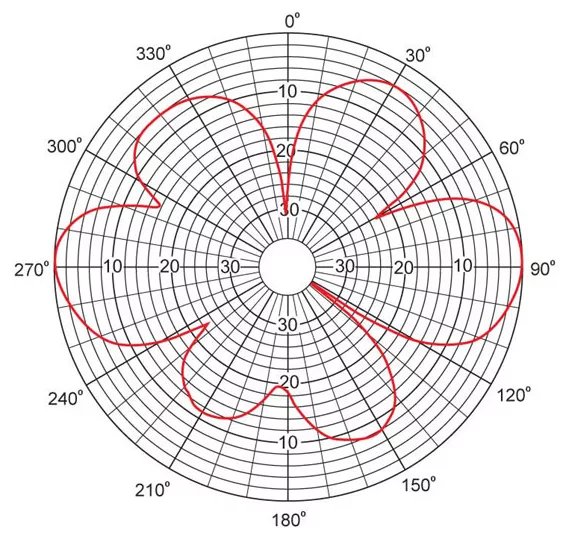
Radiation Pattern 600-6000MHz
No posts found
